 With the offshore industry largely prioritising brownfield over greenfield projects to advance optimisation and sustainability, digitalisation has been a primary driver of the transition journey.
It has facilitated complex data and process integration, eliminating hours of menial tasks so that operators are free to make prompter decisions and can attend to areas where it really matters. When the focus is set straight, complex intervention processes become simplified with quicker turnarounds at half the cost of traditional approaches.
With an ideal setup of digital asset integrity management in place, operators can remotely monitor risks at the most inaccessible parts of gigantic offshore platforms and take timely action.
Offshore environments can be accessed without arranging for ropes or scaffolding when aerial drones can reach the targeted area and click high definition images with inbuilt thermal and optical cameras. These are equipped to clearly capture splash zones, flare tips and under-deck structures.
Without diving into the ocean, everything from subsea manifolds or wellheads to pipelines can be scanned to check for leaks with the help of remotely operated or autonomous underwater vehicles. This is made easy with machine-vision artificial intelligence (AI) driving these vehicles.
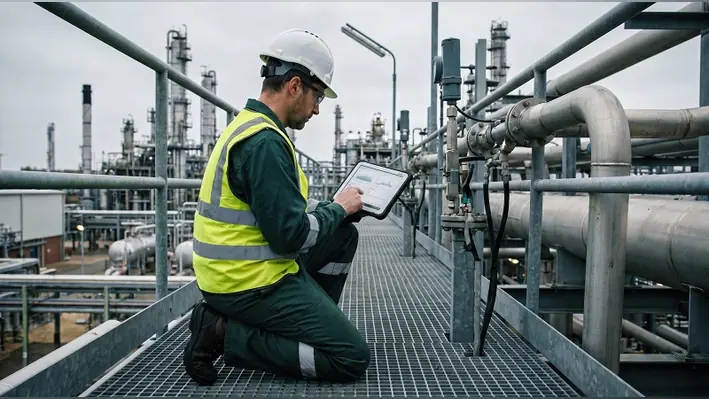
AI can also detect and track minute shifts in temperature and vibration in critical offshore turbomachinery. This helps to flag failures way ahead in time, avoiding emergency downtime situations. Non-intrusive wireless sensors, for example, can raise alarm in cases of internal sand erosion or chemical corrosion in subsea and topside pipes. When clamped to the right zones, these sensors come alive to feed consistent, real-time information on pipe wall thickness.
One of the most innovative solutions that digital asset integrity management has seen is digital twins or virtual 3D replicas of complex platforms placed deep offshore. These replicas can combine hull structural models with real-time wave, wind and mooring line tension data. They consistently update the fatigue life calculation of floating production storage and offloading (FPSO) units or tension-leg platforms.
Digital twin providers, FutureOn and SteelTrace, have collaborated to bring a one stop shop to operators, where all disconnected systems and archived documentation can be accessed in one place.
“A digital twin only delivers real value when it gives engineers immediate access to the information behind the asset. As offshore infrastructure matures, operators need trusted material information to extend asset life, support maintenance and plan for decommissioning.
“Bringing SteelTrace's verified material records directly into FieldTwin enables operations teams to quickly access the documentation they need to support maintenance, in-field repairs and decommissioning without searching across multiple systems,” said Filip Valica, vice president – corporate development at FutureOn.
Once SteelTrace’s Smart Manufacturing Records is integrated into FutureOn’s FieldTwin, a digital twin platform for offshore energy projects, operators can easily locate quality documentation, allowing faster maintenance and integrity decisions while maintaining a complete audit trail.
The integration will address a common challenge across offshore projects. Extensive data output from manufacturing and construction phase such as material test records (MTRs), weld records, coating documentation, non-destructive examination (NDE) results and fabrication sign-offs often ends up separated from the engineering models and operational systems used to manage offshore assets. The integrated solution will take care of this lack, ensuring easy access for operators.
Engineers will now be able to move directly from an asset in FieldTwin to the certificates, inspection records and manufacturing data that verify how it was manufactured, inspected and installed.
SteelTrace’s blockchain-backed Smart Manufacturing Records (SMRs) replace static PDF certificates with structured digital records that provide a verified audit trail from raw material through fabrication and installation. The integration will bring these records directly into FieldTwin, improving traceability without changing existing engineering workflows.
“Every offshore asset has a history. From the steel mill through fabrication and installation, thousands of records are created to demonstrate quality and compliance. The challenge isn't creating that information, it's making sure engineers can easily access it years later when they need it most.
“By connecting SteelTrace with FieldTwin, we're making verified material records available alongside the asset itself,” said Tom Meulendijks, CEO and founder of SteelTrace.